Homi J. Bhabha
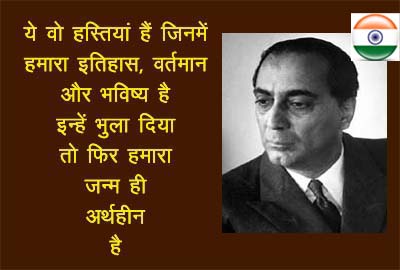
Birth 30 Oct 1909,
Death 24 jan 1966
Homi Jehangir Bhabha, a celebrated Indian scientist born on October 30, 1909, in Bombay, made significant contributions to the field of Quantum Theory. His remarkable career left an indelible mark on the scientific landscape of India.
Bhabha’s appointment as the first Chairman of India’s Atomic Energy Commission was one of his most notable achievements. His scientific career began in the field of nuclear physics in Great Britain, where he honed his skills as an Indian scientist. When he returned to India, he played a key role in convincing influential members of the Congress Party, most notably Jawaharlal Nehru, to embark on an ambitious nuclear program for the country, highlighting his status as an influential Indian scientist.
Bhabha is widely recognized as the visionary Indian scientist responsible for laying the foundation of Indian nuclear power. However, what’s less known is his unwavering stance against India developing atomic weapons, even if the country possessed the necessary resources. Instead, he advocated for the utilization of atomic reactors to alleviate the suffering and poverty prevalent in India, exemplifying his commitment as an Indian scientist to the betterment of society.
Tragically, the world lost this eminent Indian scientist in a fateful event. On January 24, 1966, Air India Flight 101, carrying Homi Jehangir Bhabha, crashed near Mont Blanc, resulting in the untimely demise of this prominent Indian scientist. The circumstances surrounding the crash spurred various theories, including a conspiracy hypothesis implicating the Central Intelligence Agency (CIA) in an alleged attempt to thwart India’s nuclear program, highlighting the global impact of his work as an Indian scientist.
Bhabha’s legacy endures, not only as a pioneer in nuclear science but also as a proponent of utilizing scientific advancements for the betterment of society and the alleviation of poverty, showcasing the humanitarian dimension of his work as an Indian scientist. His enduring vision continues to inspire the scientific community and underscores the importance of ethical and humanitarian considerations in the realm of scientific progress.
Our tributes to the great soul
www.shashvatsatya.com