Bhagat Singh
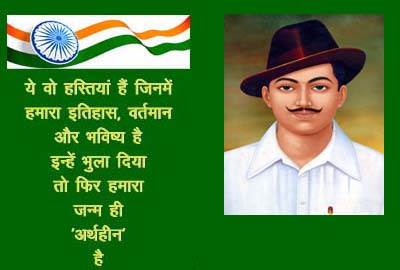
Arrival- 27 Sept 1907
Depar- 23 March 1931
Singh was born into a Jat Sikh family to Kishan Singh and Vidyavati. The exact date of his birth remains a topic of debate, with sources differing between September 27 and September 28, 1907. His desire to fight against the British was inspired by his family’s involvement in the freedom struggle, in which his grandfather, father, and uncles actively participated. In fact, his father and one of his uncles were in prison when he was born. Singh attended the local primary school in Lyallpur before moving to Lahore. There he attended Dayanand Anglo Vedic High School, which was operated by the Arya Samaj (a reform sect of modern Hinduism), and then the National College.
Singh was 12 when the Jallianwala Bagh Massacre took place in Amritsar, where British troops opened fire on a large crowd of unarmed Indians, killing hundreds and injuring more than a thousand people. This event immediately motivated him to fight for India’s freedom. He soon joined the noncooperation movement organized by Indian nationalist leader Mahatma Gandhi to press the British government of India to grant self-governance, or swaraj, to India. However, he was disappointed when Gandhi called off the movement after an incident at Chauri Chaura, during which Indian protesters broke out in violence, killing 23 police officers.
While at the National College, Singh connected with members of the Hindustan Republican Association (a radical left-wing organization), which was later renamed Hindustan Socialist Republican Association on his recommendation. In 1926 he founded the Naujawan Bharat Sabha (India Youth Association). Singh also worked as a writer and editor in Amritsar for Punjabi and Urdu newspapers espousing Marxist theories. He popularized the phrase “Inquilab zindabad” (“Long live the revolution”).
Bhagat Singh was influenced by Marxist and socialist ideas. On the day he was to be executed, he was reading Reminiscences of Lenin, a book on Russian politician Vladimir Lenin written by Clara Zetkin (Clara also spelled Klara), a German Marxist.
In 1928 Indian writer and politician Lajpat Rai was brutally assaulted by James A. Scott, the superintendent of police, while leading a silent march opposing the Simon Commission—a 1927 British-appointed body tasked with reviewing the working of the Indian constitution established by the Government of India Act of 1919. Though Rai survived the attack, he succumbed to his injuries shortly thereafter. Singh, along with his associates Sukh Dev Thapar and Shivaram Rajguru, plotted to kill Scott to avenge Rai’s death. Instead, in a case of mistaken identity, the assistant superintendent of police, J.P. Saunders, was killed. While fleeing, Singh and his associates were aided by their fellow revolutionary Chandrashekhar Azad, who shot a police constable who was pursuing them. Singh then fled to Lahore to escape the death penalty. In 1929 Singh and his associate, Batukeshwar Dutt, lobbed two bombs at the Central Legislative Assembly in Delhi to protest the introduction of two repressive bills—the Public Safety and the Trade Disputes bills.
As a result of Saunders’s assassination, Singh, Rajguru, Thapar, and 12 others were sent for trial under the Lahore Conspiracy Case (1930). While in jail during the trial, Singh helped organize a hunger strike to protest the ill treatment of prisoners, a demonstration that gained him wide support in India. The court ruled that Singh, Rajguru, and Thapar would be hanged for the murder of Saunders. They were executed and cremated in Lahore on March 23, 1931. This day is now observed as Martyrs’ Day in India to honor the sacrifice of Bhagat Singh and his associates during the freedom struggle.