-Can God ever sleep…?
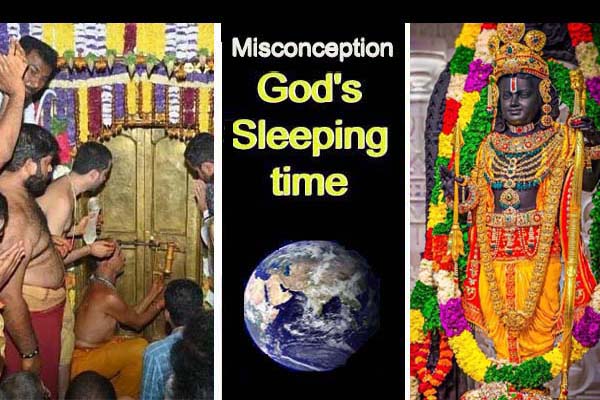
There are rules for the entry and exit of devotees at the sacred places of every religion. In Sanatan Dharma, that is, Hinduism, the rules for worship at temples and other religious places, along with their timings, have been prescribed. The doors of temples open during Brahma Muhurta, that is, at around 4 a.m., and they are closed same day at about 12 noon. After four hours of rest, the temple doors reopen at 4 p.m., before evening sets in, and are closed again after 10 p.m.
Regarding the period when the temple doors remain closed, it is propagated in Sanatan Dharma that this is the time when God “rests,” and after 10 p.m., “God also goes to sleep.” Therefore, the temple doors are closed at that time. It is also said that one should not worship God during this period because it disturbs His sleep or rest, making God displeased.
Although other religions also have different rules regarding their sacred places, we wish to place this question before the intellectual community and religious scholars concerning the timings of devotees’ visits to temples associated with Sanatan Dharma: Why do the Hindu scriptures, which claim that God governs the entire Earth, impose fixed restrictions on the timings of devotees’ entry into temples by asserting that “God is resting or asleep at this time”…?
While both religious scholars and science also claim that the visible forms of God are the Sun and the Moon, which continuously revolve around the Earth, that is, they keep circling the Earth without ever stopping, and determine the course of life and death for humans, living creatures, and animals across the entire world according to their respective ways of existence.
A question that challenges religious administrators
I believe that the hands of the cycle of time keep moving continuously for 24 hours without stopping. Since humans, animals, and all living creatures have life in their bodies, after a few hours of work they need rest, and then they wake up and resume their respective activities.
In other words, after a certain period, when the body becomes exhausted and loses its vigor, it demands rest. This rest also includes sleep, which follows its own cycle over a 24-hour period. Thus, when the doors of temples are opened at 4 a.m. during Brahma Muhurta, the priests and temple attendants also wake up. By the time it is 12 noon, they have already been active for 8 hours, so they too wish to rest for some time and attend to other tasks related to the cleanliness and management of the temple. The same question applies after 10 p.m., when the temple doors are closed. After about 6 hours of work, the bodies of the temple priests and attendants also seek rest. It is during this period of rest that the priests and attendants regain their physical energy, refreshing them for the following morning.
In the context of the divine claims of Sanatan Dharma, my personal experience-based reasoning seems more significant: the God who governs the entire earth, who gives life to human beings, determines their future, has them perform various actions over time, and then one day takes the lives of those same humans, animals, and living creatures, can never sleep. In other words, God can never sleep because He has to oversee the countless activities taking place across the entire earth.
A living example of this is that a baby can be born at 2 or 3 o’clock in the middle of the night, and a person can also breathe their last at any time during the 24-hour day. In other words, God in the form of Yamaraj can come at any time and complete His task. Countless “souls” are born from their mothers’ wombs every day, around the clock, and countless souls leave their bodies within the same period. Therefore, the God who governs this earth never sleeps, and His work continues without interruption. The timings associated with temples and other religious rituals were established solely by humans in ancient times for the sake of order or convenience, and over time those timings became part of tradition and habit.
-How much do you agree with this argument? Please do share your opinion.