Sir C.V. Raman
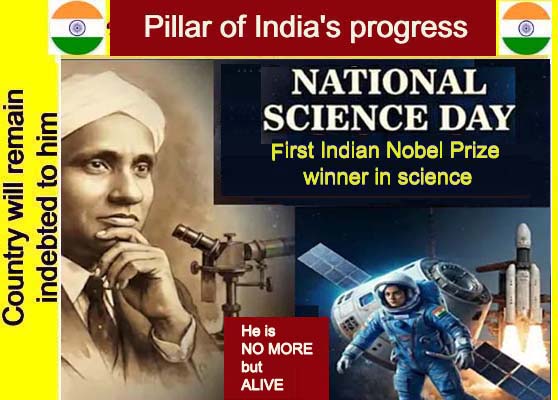
Birth: November 7, 1888
Death- November 21, 1970
Sir C.V. Raman (1888–1970) was a pioneering Indian physicist who won the 1930 Nobel Prize in Physics for discovering the “Raman Effect,” which explains how light scatters when passing through transparent materials. He was the first Asian to receive a Nobel Prize in science and was later honored with the Bharat Ratna in 195
In India, National Science Day is observed to honour Raman’s discovery of the scattering of light, known as the Raman Effect, announced on February 28, 1928.
Birth: Born on November 7, 1888, in Tiruchirappalli, Tamil Nadu, to a father who lectured in mathematics and physics.
Education: A child prodigy, he finished high school at 11 and completed his Bachelor’s at age 16, topping his class at Presidency College, Madras. He earned his Master’s in Physics at 19.
Finance Service & Research: Initially joined the Indian Finance Service to support himself, yet conducted groundbreaking research on acoustics and optics in his spare time.
Academic Shift: Became the Palit Professor of Physics at the University of Calcutta in 1917.
The Raman Effect (1928): Discovered that when light traverses a transparent material, some of the deflected light changes in wavelength, a phenomenon known as “Raman scattering”.
Institutions: Served as a professor at the Indian Institute of Science, Bangalore, and later founded the Raman Research Institute in 1948
Legacy and Awards
Nobel Prize (1930): Awarded for his work on the scattering of light.
Awards: Knighted by the British government in 1929 and awarded the Bharat Ratna, India’s highest civilian honor, in 1954.
National Science Day: February 28, the day he discovered the Raman Effect, is celebrated annually as National Science Day in India.
He passed away on November 21, 1970, leaving behind a legacy of independent thinking and dedication to science (updated from google search)