Shakuntala Bhagat
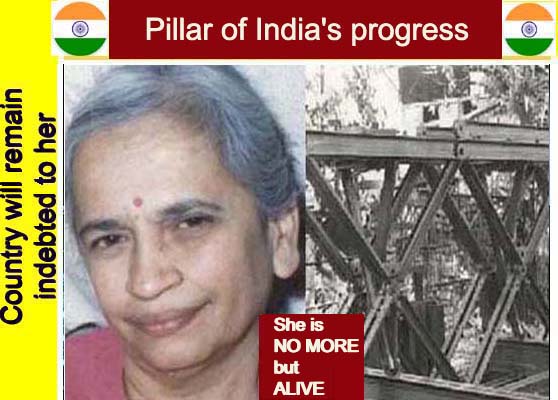
Birth-February 6, 1933
Death -October 14, 2012
Inventor of Designing Bridges
India’s First Woman Civil Engineer Spent Decades Designing Bridges That Still Support Remote Regions Today
Decades before India spoke about women in STEM, Shakuntala Bhagat was designing bridges that carried people across the country’s toughest terrains. From a small Bombay workshop to over 200 bridges across India, her ideas reshaped the way the nation builds.
Our country, India, is not rich today, but it is not poor either. The country awaits the day when every Indian will be prosperous, educated, empowered, and well-behaved. Our portal www.shashvatsatya.com also remembering and paying tribute to those personalities who have given India a new lease of life with their knowledge, science and inventions but his or her names are in darkness and only countable persons knows about them.
On a chilly morning in the late 1950s, workers at a construction site in Bombay paused for a moment. A young woman stepped onto the site carrying rolled-up drawings under her arm, scanning columns of steel and concrete with a calm, practised eye. It was a sight they were not used to. Engineering, especially on ground like this, belonged almost entirely to men.
That woman was Shakuntala Bhagat, and she was about to redefine how India built its bridges.
Long before conversations about women in STEM became mainstream, she was already shaping the country’s infrastructure with ideas far ahead of her time.
Shakuntala completed her civil engineering degree from Victoria Jubilee Technical Institute (now VJTI) in 1953, becoming one of the first women in India to do so. A decade later, she earned her MTech in Civil Engineering from the University of Pennsylvania.
Her career began in academia. From 1960 to 1970, she taught at IIT Bombay as an assistant professor, immersing herself in structural engineering and heavy construction. She believed that engineering should solve real, urgent problems faced by people.
In 1968, their small Bombay apartment doubled as a workshop. Sketches filled the walls, steel samples sat on the table, and late evenings often turned into problem-solving sessions. From this space, Shakuntala and her husband started ‘Quadricon’, a bridge design firm built around their idea for a new kind of modular system.
Her work soon took her to the United States, Germany, and the UK, where she studied structures and researched concrete at the Cement and Concrete Association of London. No matter where she went, she noticed the same pattern. Steel was strong and dependable, yet many engineers avoided it because connecting its parts was slow and relied on outdated welding and riveting.
Shakuntala felt India needed a system that matched its terrain and pace.
The breakthrough came from a simple question: What if bridges could be modular, lightweight, and easy to assemble?
This led to the ‘Unishear Connector’ — a structural joint that allowed steel parts to lock together with clean, intelligent precision. No slow welding. No unreliable riveting. Just simple, robust interlocking that cut construction time dramatically.
Engineers had never seen anything quite like it in India.
In 1972, this innovation won Shakuntala and Subhang the highest honour from the Invention Promotion Board, sealing their place as pioneers of a system that would soon transform bridge-building across the country.
Building bridges in record time: From Spiti to Arunachal
Quadricon’s first big test arrived in 1972. The couple built two modular bridges in Spiti, Himachal Pradesh, in just four months. They did this without heavy machinery, working in extreme terrain where conventional construction would have taken far longer.
As word spread, demand went up.
By 1978, their patented system had enabled the construction of 69 bridges across India, stretching from Kashmir to Arunachal Pradesh.
Shakuntala was honoured as ‘Woman of the Year’ in 1993. She passed away in 2012 at the age of 79, leaving behind designs and systems that continue to carry travellers safely across some of India’s toughest landscapes. (Courtesy Internate website- in favour of country and for motivation to citizens)(UPDATED ON 3RD FEB 2026)